
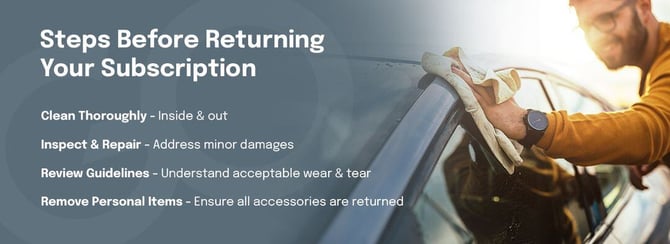
Vehicle Condition Guidelines (Overview)
The purpose of the Guidelines listed below are to provide with peace of mind in advance of the return of your Subscription.
Maintenance Responsibilities
Under the Terms of your Subscription you agreed to have your subscribed vehicle serviced as outlined by GO. Please refer to your Terms & Conditions as well as GO’s website (www.drivego.com) to make sure you followed maintenance policies and schedules.
"Excess wear and use" responsibilities
As stated in your Terms, you are responsible for excess wear and use. The Vehicle Condition Guidelines help define what is considered excess wear and use and will help determine the condition of your vehicle, including its interior, exterior and mechanics. Generally, when there's damage, there is excess wear and use. And according to your Terms, you are financially responsible for its repair. It is important to note here that if a vehicle is returned unrepaired excess wear and tear, in addition to the cost of the repairs you will be responsible for an administration fee to GO to manage the repair process. This fee (currently $495 + tax) covers a portion of the costs involved with transportation of the vehicle, getting estimates, and managing the repair process. Below you will find specifics on when damage is considered excess wear and use.
Safety Issues
As your Terms state, anything that makes the vehicle unsafe or unlawful to operate is also considered damage. This includes incomplete safety recalls, engine and other warning lights, damage to the restraint system, etc.
Mileage Provision
When you accepted your Terms, you agreed to drive up to a certain number of miles on a monthly basis. If your mileage is over that amount when you return your vehicle, there will be an excess mileage charge. (Refer to Schedule 2 of your Terms and Conditions.)
The Vehicle Condition Guidelines were developed in response to input from customers like you. They offer clear, concise parameters so there are no surprises at lease end. In addition to being easy to understand, they are also fair, taking into consideration that wear and use are a normal part of driving. As long as your GO vehicle meets these established guidelines, it will be considered free of excess wear and use.
One way to easily determine what likely is and what isn't considered excessive damage is The Wear-and-Tear Card Test. It's simple. Generally, if exterior or interior damage can't be seen when placing the downloadable Wear-and-Tear Card tool over it, then it likely "passes the test" and you most likely won't be charged.*
*Further details apply
Vehicle Condition Guidelines & The Wear-and-Tear Card Test
Interior & Exterior Condition GuidelinesThe following are examples of what would NOT meet subscription return guidelines when inspecting your vehicle's interior & exterior:
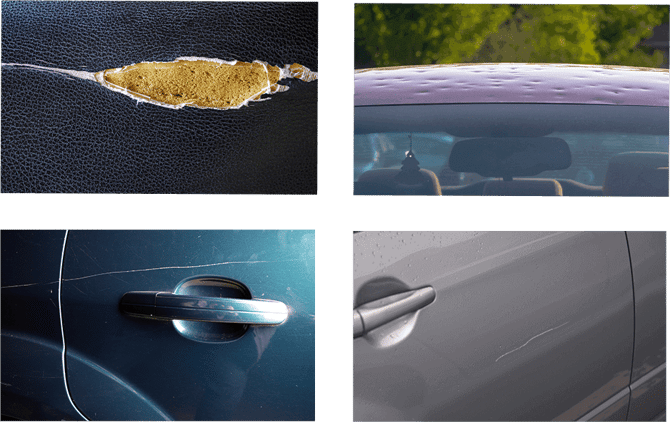
- Any scratch through the paint larger than the size of The Wear-and-Tear Card. (Scratches that do not go through the paint may pass The Wear-and-Tear Card test, depending on number of scratches.)
- The third and each subsequent scratch per panel that is through the paint and smaller than the size of The Wear-and-Tear Card.
- More than 2 scratches per panel regardless of whether they go through the paint or exceed the Wear-and-Tear Card measurement; more than 10 total on the vehicle.
- Tears, cuts, holes, or burns to the interior, regardless of size.
- Any dent that is larger than the size of The Wear-and-Tear Card.
- More than 2 dings/dents on any panel regardless of size; more than 8 total on the vehicle.
- Any damaged safety items, regardless of size (e.g., torn seat belts).
- Collective damage that is caused by a single event, regardless of size (e.g., hail damage).
- Any holes, cracks, gouges, tears, or cuts in the sheet metal or bumper, regardless of size.
- Glass or lights that have cracks, stars, holes, or plugs (a star is a chip with one or more legs, and a plug is considered unsafe for vehicles with supplemental restraint systems).
- There is evidence of cigarette smoke or pet hair.
- Sub-standard repairs exist (“fish-eyes” in paint, loose parts, etc.).
- Stains that are permanent or interior condition that would require more than just a basic cleaning.
Examples that DO NOT meet " Wear-and-Tear Card Test ":
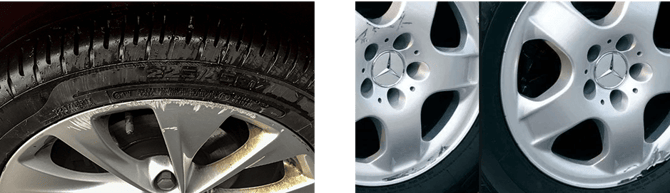
The following are examples of what would NOT meet subscription return guidelines when inspecting your vehicle's rims, and tires:
- Wheels that are cracked or bent.
- Wheels that are not those originally equipped with the vehicle at time of delivery.
- Rims that are bent or have breaks (regardless of size)
- Tires with less than 1/8" (or 4/32”) tread depth (use The Wear-and-Tear Card to measure).
- Tires that have sidewall damage (which includes plugs and cuts), bulges, or exposed cords.
- Tires that are mismatched: Tires on each axle that are not the same size, brand, model, type and/or speed rating, and equivalent in quality and performance to the original tires.
- Spare tire and rim (or inflation kit for those vehicles without a spare tire) that are missing or not in operable condition.
Mechanical & Electrical Condition Guidelines
The following are examples of what would NOT meet subscription return guidelines when inspecting your vehicle's mechanical & electrical systems:
- Maintenance specified by GO has not been performed and documentation not provided.
- Safety recalls communicated to you by GO have not been completed.
- Any warranty repairs have not been completed.
- There are error and/or warning lights on.
Aftermarket Modification Guidelines
The following are examples of what would NOT meet subscription return guidelines when inspecting your vehicle's aftermarket status:
- Per your Terms, no alterations should have been made to the GO vehicle without our advance written consent. Any unapproved alterations to the vehicle are considered excess wear & tear.
Missing Parts
Prior to turn-in, be sure to remove all personal items from the vehicle, complete all scheduled maintenance or repairs, and ensure all originally equipped items (if applicable) are returned with your vehicle. These items include, but are not limited to:
- Second key
- Owner’s manuals
- Charging cords
- DVD system
- Remote controls
- Headphones for entertainment system(s)
- Navigation disc or SD card
- Headrests
- Cargo cover
- Tool kit
- Spare tire
Both images to the left and right would NOT meet the guideline
Note: Windshield replacements are often covered by insurance. Please ask your insurance agent. If you choose to make any replacements after your subscription-end inspection, contact the GO Service Team at service@drivego.com. Please note that repairs performed after return may be subject to additional fees and charges.
If you have any questions are unsure if there is something you should take care of, please reach out to us via email service@drivego.com. We will be happy to assist.
